

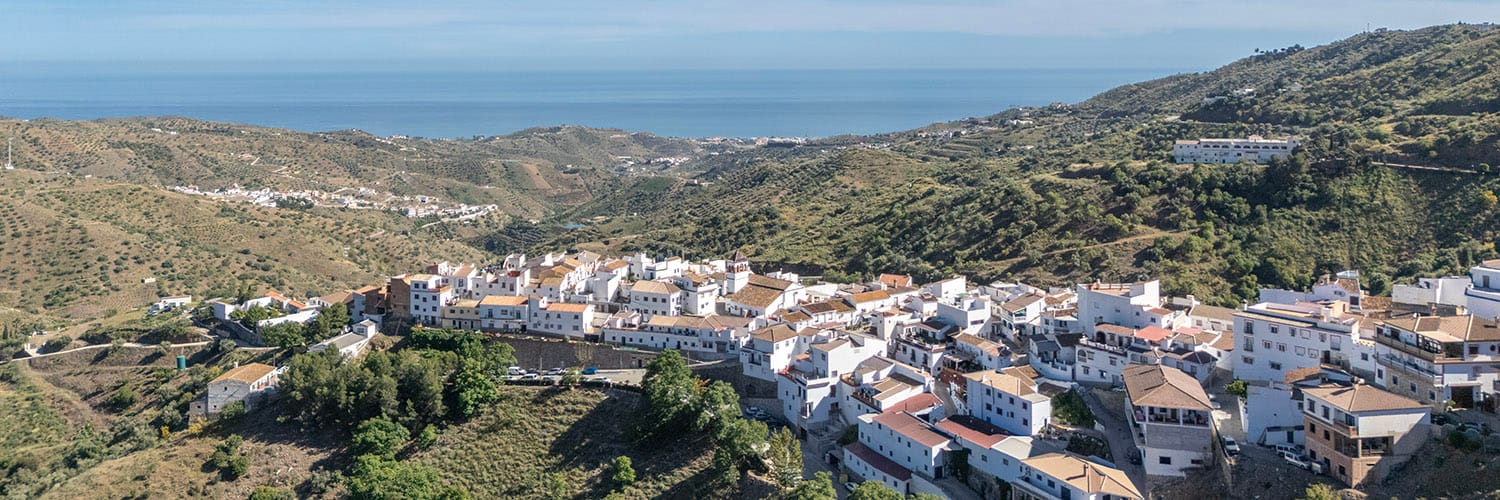
Moclinejo
Set in the western Axarquía, above the coast and inland from Rincón de la Victoria, Moclinejo is one of the key villages of the traditional raisin and moscatel wine landscape. It is often described as the gateway to the Ruta de la Pasa, and that is a good way to understand it. This is a village shaped by vines, steep hillsides, paseros, local wine, olive oil and the hard agricultural work that has defined this part of Málaga for generations.
Moclinejo is not a coastal settlement, but it is close enough to the sea to feel connected to the western side of the East of Málaga region. It sits in a hilly landscape of vineyards, olive trees, almond trees and dry terraces, with views opening towards the surrounding countryside and, from some points, down towards the Mediterranean. The village has a strong rural identity, but it is also within reach of Rincón de la Victoria, Málaga city and the coast by car.
For people looking at the Axarquía as somewhere to live, Moclinejo offers a particular mix: traditional village life, agricultural landscape, cultural depth, good access to the coast and city, and a quieter, more Spanish feel than the larger coastal towns.
The Village and Its Setting
Moclinejo is a compact white village built on uneven ground, with narrow streets, whitewashed houses, tiled roofs, small squares and corners that reflect its Moorish origins. Like many villages in the Axarquía, its layout follows the slope of the land rather than a formal plan, giving the village a natural, irregular character.
The surrounding countryside is central to Moclinejo’s identity. This is classic moscatel country. The steep slopes around the village are planted with vines used for raisins and wine, alongside olive and almond trees. The landscape is practical rather than ornamental, but it is also very beautiful, especially when the light catches the patterned hillsides and the paseros where grapes are dried in the sun.
Moclinejo feels more rural than nearby coastal places such as Rincón de la Victoria, Torre de Benagalbón or Chilches, but it is not remote in the way that some of the northern Axarquía villages can be. Its position gives it one of its great strengths: inland character with relatively good access to larger towns and the sea.
Local Life and Amenities
Moclinejo has the everyday amenities you would expect from a small inland village, including local bars, shops, municipal services and community facilities. It is not a large service centre, so residents will generally travel to Rincón de la Victoria, Málaga city, Vélez-Málaga or Torre del Mar for larger supermarkets, hospital appointments, specialist shopping, schools beyond local provision and wider professional services.
A car is strongly recommended. Although Moclinejo is better connected than many more remote inland settlements, daily life is much easier with your own transport. This is especially true for anyone living outside the main village or in one of the surrounding rural properties.
For people who want to live inland but still need regular access to Málaga, the airport, the coast or larger shops, Moclinejo may be more practical than it first appears. It offers rural village life without feeling completely cut off.
Wine, Raisins and Local Identity
Moclinejo’s strongest identity is tied to the vine. The village is part of the Ruta de la Pasa, the traditional raisin route of the Axarquía, and is closely associated with moscatel grapes, local wine, raisins and the families who have worked this difficult landscape for generations.
The Fiesta de Viñeros is one of the most important events in the village calendar. Held in September, it pays tribute to the vineyard workers and the traditional processes connected with the grape harvest, raisin-making and wine production. Demonstrations, music, local food and wine help turn the streets into a celebration of the village’s agricultural roots.
This matters because Moclinejo is not simply using wine and raisins as tourist branding. These traditions are part of its history, its economy and its local pride. The hills around the village make that clear. The landscape tells you what people here have been doing for centuries.
History and Things to See
The Church of Nuestra Señora de Gracia is the main historic building in Moclinejo. Built between the 16th and 17th centuries, it stands out within the village and remains an important religious and architectural landmark.
The village also has attractive corners, arches, viewpoints and streets worth exploring on foot. Moclinejo is not a polished show village, and that is part of its charm. It feels lived-in and connected to its agricultural surroundings, with a stronger emphasis on local identity than on tourism.
Visitors may also come across ceramic details, decorated corners and small cultural features that add colour and personality to the village. The wider municipality includes El Valdés, which has its own distinctive character and the Casa Museo Axarquía, so we treat El Valdés separately rather than folding it into this overview.
Countryside and Outdoor Life
The countryside around Moclinejo is one of its main attractions. The hills are marked by vineyards, olive groves, tracks, paseros and small rural properties, creating a landscape that is ideal for walking, photography, scenic drives and exploring the western Axarquía.
This is not high mountain country like Alfarnatejo, nor is it soft coastal suburbia. It is steep, agricultural and sun-exposed, with routes that reveal views towards the sea, the inland hills and neighbouring villages. Anyone interested in food, wine, rural life or traditional agriculture will find Moclinejo especially rewarding.
The climate is generally milder than in the higher northern villages, but summers can still be hot, particularly on exposed slopes. For anyone considering living here year-round, orientation, shade, ventilation and access are all worth thinking about carefully.
Lifestyle and Community
Moclinejo is likely to suit people who want a traditional inland village within reasonable reach of the coast and Málaga. It may appeal to retirees, remote workers, couples, walkers, wine lovers, food lovers and people who prefer a more Spanish village atmosphere to a large international community.
It is not the obvious choice for someone who wants beach life, nightlife or a wide range of services on the doorstep. Nor is it as well known among foreign buyers as places such as Cómpeta, Frigiliana or Nerja. For some people, that will be a drawback. For others, it will be exactly the attraction.
As with many inland villages, speaking Spanish or being willing to learn will make life much easier and richer. Moclinejo is friendly, but it is not an international resort. It is a working local village with its own rhythms, traditions and expectations.
Property and Real Estate
Property in Moclinejo is likely to interest buyers looking for inland character, views, value and access to both the coast and Málaga. In the village, there are traditional townhouses, renovated homes and properties with terraces or outlooks across the surrounding hills. In the countryside, there may be fincas, vineyard properties, rural houses and homes with more land and privacy.
The usual Axarquía checks apply. Buyers should look carefully at access, legal status, water, electricity, internet, drainage, boundaries, road conditions, parking and orientation. A rural property with wonderful views can be ideal, but the practical details make a huge difference to daily life.
Why Choose Moclinejo?
Moclinejo is a strong choice for people who want a traditional inland village with real agricultural and cultural identity. It offers whitewashed streets, vineyard landscapes, moscatel wine, raisins, local fiestas, views and a practical position within reach of Málaga and the coast.
It is not a beach town, a resort or a large service centre. Its appeal is quieter and more rooted.
For the right person, Moclinejo offers one of the most authentic inland options in the western Axarquía: rural, local, wine-growing, characterful and close enough to the coast to make everyday life practical.
All Moclinejo Pages
Overview
Reasons to Live Here
Property at a Glance
Local Highlights
Schools, Healthcare and Transport
Local Fiestas and Events
Stay, Eat and Drink
Sports and Outdoor Activities
Business and Economy
Further info about Moclinejo.