

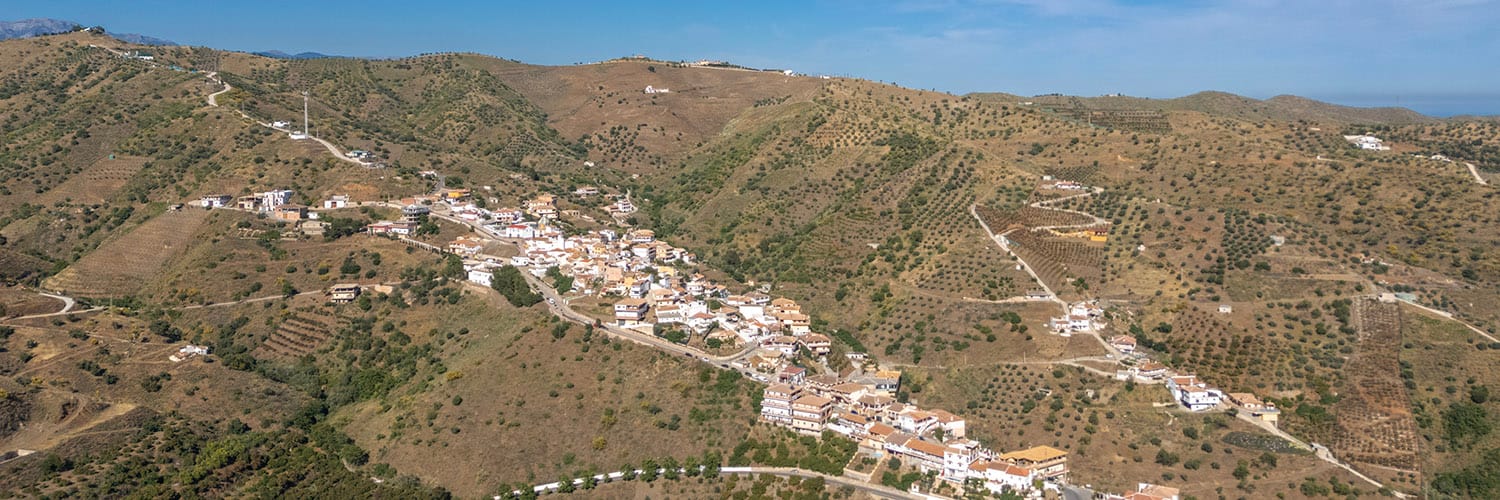
El Valdés
Set in the western Axarquía, within the municipality of Moclinejo, El Valdés is a small inland hamlet with far more character than its size might suggest. It sits among the dry hills, vineyards, olive trees and white villages that define this part of the East of Málaga, close to the traditional raisin and moscatel wine landscape for which the area is known.
El Valdés is not a municipality in its own right, and it should not be approached in the same way as larger villages such as Moclinejo, Benagalbón, Colmenar or Comares. Its appeal is smaller, more specific and more unusual. This is a compact rural settlement with a strong local identity, a peaceful setting and one very distinctive cultural landmark: the Casa Museo Axarquía, created by Antonio Montañez, often referred to locally as the “Gaudí of the Axarquía”.
For visitors, El Valdés is a place to discover rather than somewhere likely to dominate a whole day. For people thinking about living in the East of Málaga, it represents a very particular kind of inland lifestyle: small-scale, local, quiet and rural, but still within reach of Moclinejo, Rincón de la Victoria, Málaga city and the coast by car.
The Hamlet and Its Setting
El Valdés belongs to Moclinejo municipality and sits in the hilly landscape of the western Axarquía, where the countryside is shaped by vineyards, olive groves, almond trees, dry-stone terraces and rural tracks. This is part of the broader moscatel and raisin-producing area, where the steep slopes, paseros and traditional agricultural methods have helped define local life for generations.
The hamlet itself is small and whitewashed, with a modest, rural feel. It does not have the scale or range of services of a larger village, and that is central to understanding it. El Valdés is not a place of busy streets, large shops or tourist infrastructure. It is a quiet settlement where the surrounding countryside, local traditions and a handful of distinctive features give it its identity.
The location makes it interesting. El Valdés feels rural and tucked away, but it is not lost in the mountains. By car, it connects into the wider western Axarquía, with Moclinejo nearby, the coast below, and Málaga city more accessible than from many of the higher or more easterly inland villages.
Casa Museo Axarquía
The best-known feature of El Valdés is the Casa Museo Axarquía. Created by Antonio Montañez, a local resident and craftsman, the building is one of the most unusual sights in the area. Its exterior is decorated with colourful ceramics, mosaics, tilework and locally inspired details, turning what might otherwise be an ordinary village building into a striking piece of folk architecture and personal artistic expression.
The comparison with Gaudí is easy to understand, especially because of the use of ceramics, colour, pattern and decorative surfaces. However, the value of the Casa Museo Axarquía is not that it imitates Barcelona. Its real importance is that it belongs to this landscape. It draws on local materials, local craft, local memory and the identity of the Axarquía itself.
Inside, the museum includes works and objects connected with the area, while outside, the surrounding spaces have also been decorated with ceramics and mosaics. For a hamlet of this size, the effect is surprising. El Valdés feels as though someone has taken the time to turn parts of the village into a small open-air celebration of the Axarquía.
Plaza Axarquía and Local Craft
The artistic character of El Valdés is not limited to the Casa Museo. Plaza Axarquía is also decorated with mosaics, tiles and colourful details, again associated with Antonio Montañez and the local craft tradition. This gives the hamlet a visual identity that is quite different from many other small settlements in the area.
One of the most meaningful local features is the homenaje to the picapedreros, the stone workers who were once an important part of the municipality’s working life. The tribute reflects a harder, older rural economy, when stone extraction and craft labour were part of the local landscape.
This connection with stone, ceramics, agriculture and handwork gives El Valdés a strong sense of place. It is not simply “a small hamlet near Moclinejo”. It has its own story, told through materials, surfaces, names and local memory.
Local Life and Amenities
El Valdés is very small, so expectations need to be realistic. It does not offer the facilities of a larger inland village. For shops, bars, municipal services, schools, healthcare, larger supermarkets and administrative needs, residents will generally look to Moclinejo, Rincón de la Victoria, Málaga city or other nearby towns depending on what they need.
A car is essential for almost anyone living here. The appeal of El Valdés is peace, rural character and a close connection to the landscape; the trade-off is dependence on nearby villages and towns for most practical services.
For some people, that will be a drawback. For others, it will be exactly the point. El Valdés is likely to suit people who want quiet surroundings, a small community, countryside views and a slower rhythm, while still being within reach of the coast and Málaga by road.
Lifestyle and Community
Life in El Valdés is local, rural and small-scale. It may appeal to retirees, remote workers, artists, writers, walkers, photographers and people who prefer a hamlet atmosphere to a larger village or coastal town. It is not a place for someone looking for nightlife, a large international community or a full range of services on the doorstep.
The surrounding landscape is part of daily life. The hills, vineyards, tracks and views connect El Valdés to the wider Ruta de la Pasa and the moscatel traditions of the western Axarquía. The annual rhythms of the countryside still matter here: pruning, harvesting, drying, fiestas, food and family networks.
As with many small inland settlements, speaking Spanish or being willing to learn will make a significant difference. El Valdés is not built around foreign residents. It is a local hamlet, and anyone moving here would need to respect that scale and character.
Fiestas and Traditions
El Valdés has its own festive identity within the Moclinejo municipality, including local celebrations and romería traditions. These events are important because in a small hamlet, fiestas are not simply entertainment. They are part of how the community gathers, remembers and maintains its identity.
The wider Moclinejo area is also strongly associated with wine, raisins and verdiales, especially through the Fiesta de Viñeros in Moclinejo, which celebrates the vendimia and the families who work the vineyards. El Valdés sits within that wider cultural and agricultural landscape.
Property and Real Estate
Property in El Valdés is likely to interest a very specific kind of buyer. This is not a place with a wide and varied property market. Homes may include traditional village houses, small renovated properties and rural homes in the surrounding countryside.
The usual Axarquía property checks are especially important in a small hamlet. Buyers should look carefully at access, parking, legal status, water, electricity, drainage, internet, boundaries, orientation and road conditions. A peaceful rural house can be idyllic, but daily life depends on practical details.
Anyone considering El Valdés should also think carefully about scale. Some people want the facilities and social life of a larger village. Others want quiet, views and a small community. El Valdés belongs firmly in the second category.
Why Choose El Valdés?
El Valdés is a good choice for people who want a tiny inland locality with a distinctive identity, rural surroundings and an unusual artistic landmark. It offers peace, countryside, moscatel landscape, local craft, ceramic decoration, the Casa Museo Axarquía and easy access by car to the wider western Axarquía.
It is not the obvious choice for someone who wants beach life, shops, restaurants and services within easy walking distance. Nor is it a conventional tourist village.
For the right person, El Valdés offers something much more particular: a small hamlet with local character, artistic detail, agricultural roots and a quiet position between the coast, Moclinejo and the hills of the Axarquía.
Further info about El Valdés.
A Facebook group for El Valdés and Moclinejo
The El Valdés page on the Visit Moclinejo website.